Run a puzzle challenge for your team.
A custom event is a step challenge for your brain. Do a puzzle, get a point, repeat — a few short puzzles a day, on everyone's own phone, scored between clubs. And like a step challenge, nobody cares how fast you were: only that you showed up, and which club you showed up for.
Dayzle is a daily puzzle app — Sudoku, word games and visual logic, across more than twenty games. You run the event yourself and it's private to the people you invite: up to 50 of them, for one, two or four weeks, free to set up. Nobody outside it can see it, find it or join it. This page is the whole thing — how to run one, what to send the people you invite, and what it asks of them.
That opens the Events tab in your browser. You'll be asked to sign in — an event needs an account, even though playing Dayzle doesn't.
Team building that costs nobody an afternoon.
Step challenges catch on because the thing you're doing is good for you, you're doing it alongside people you know, and everyone ends up pushing everyone else to do a bit more. Those are the same three reasons this works.
Ten Minutes, and No Meeting
Nobody has to be anywhere, book anything, or be in the same country. People play on their own phone whenever suits them — on the bus, over coffee, at 11pm.
Nothing to Buy or Expense
Dayzle is free, an event is free to set up and free to join, and there's no seat count to approve. Nobody has to put anything through the company.
Something to Talk About That Isn't Work
Everyone in the event plays the same boards on the same day, so there's a thing to say to each other in the morning that isn't a status update.
Fun With 2, Great With 20
Two people in two clubs is enough to start one, and fifty is the ceiling. Twenty is where it sings — four clubs of five, a standings table worth checking each morning, and a close finish. You can invite more people after it has started, too.
One event, a few clubs, ten minutes a day.
An event is one time-boxed challenge with one organizer: a start, an end, clubs, boards and a winner. This is the whole shape of it.
- 1
Set It Up
Name the event, pick what you're scoring, choose a start date and whether it runs one, two or four weeks, and say how many clubs. Everything else has a default and folds away under Advanced Options.
- 2
Invite People
Paste a list of email addresses, or tick people from your Dayzle friends. Everyone gets their own single-use link, which you can also copy and hand over in Slack, Teams or a text.
- 3
It Opens, Then It Starts
Nothing is sent until you tap Open Event and Send Invites. The event then starts by itself at the time you chose — or you tap Start Now once two people are in.
- 4
Everyone Plays the Day's Boards
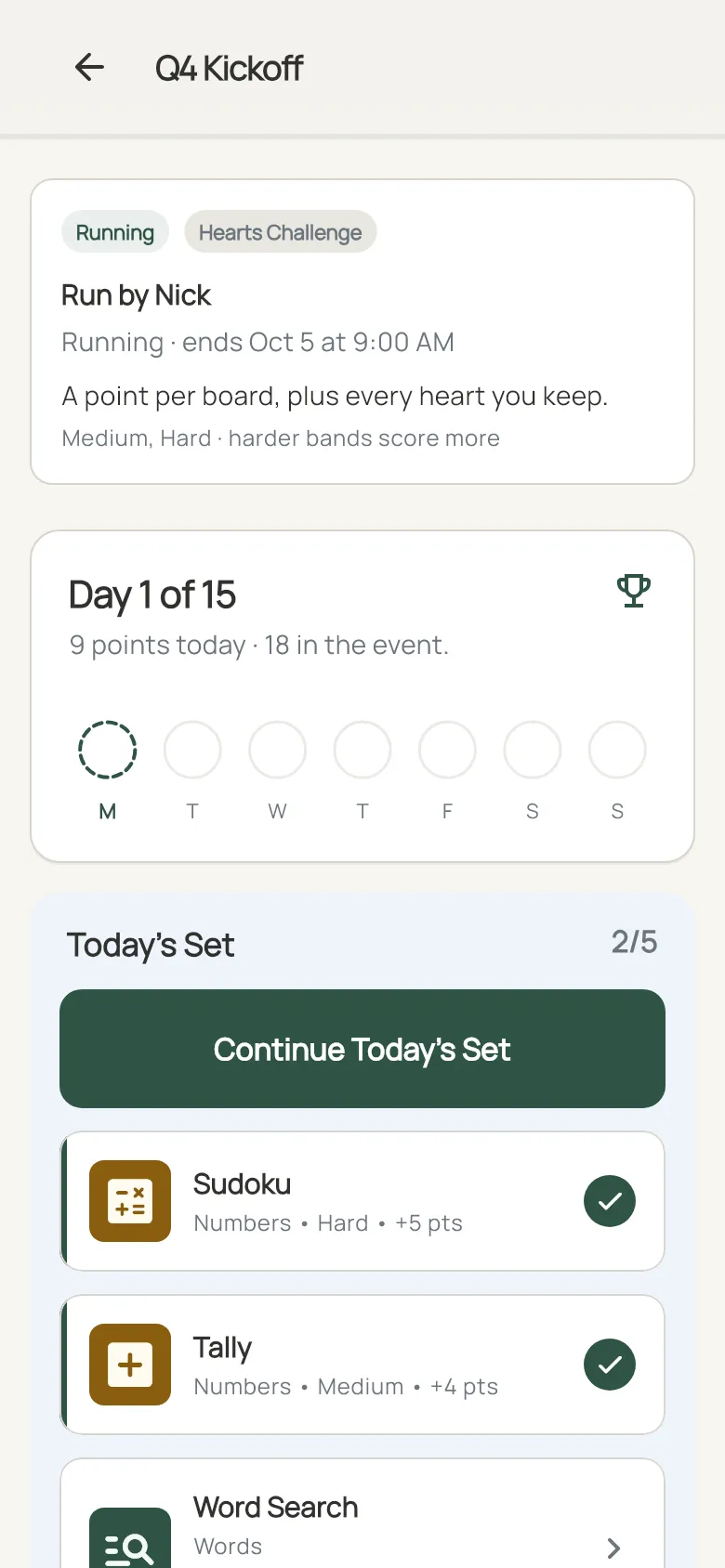
Up to five short puzzles a day, on each person's own phone. They're the same boards for everyone in the event, generated for that event alone, so nobody has played them before.
- 5
Clubs Are Scored, Somebody Wins
Standings by day, by week and over the whole event, for people and for clubs. Medals each day and week. At the end, a final table and a share card for the group chat.
-
The Three Words
An event is the whole challenge. A club is a group inside it, scored together — the way a book club is a group. The challenge is the rule that turns a finished puzzle into points.
Only if you set it up to be.
The thing that stops people joining a workplace challenge is the suspicion that it will quietly rank everybody. It doesn't have to, and the reasons are settings and scoring rules anyone can check. This is the section worth forwarding to the people you invite.
It's private to you and the people you invite
An event is invite-only and unlisted. There's no directory to browse, no search, and no shared code anybody could pass on — the only way in is an invite made for one person, which works once and can be taken back. Its name, its clubs and its standings are readable by the people in it and nobody else, and that's enforced by the server rather than by hiding a button.
None of it leaves the event, either. The points, the medals and the winner stay inside it — nothing from an event appears on Dayzle's public leaderboards or in anyone's app-wide medals.
Finishing Is What Scores
On Hearts — what a new event uses — a board you finish always scores, even if you needed a refill to get there. Streak rewards turning up day after day, Accuracy rewards care, and Speed is the only challenge that rewards being quick: one option out of five, and the organizer picks.
Nobody Can Outrun You
On Hearts and Accuracy the score is capped: a board finished cleanly is worth the same whether it took four minutes or twenty. Whoever talked you into this can beat you, but only by a little — and only for their own club.
One Difficulty, Unless You Want More
A new event allows Medium only — the same comfortable middle the daily set is served at — and Harder Bands Score More is off unless the organizer turns it on, so an Easy board and an Extra Hard board earn the same. Allow more, and each player picks their own board by board.
Hints Don't Cost You Points
Stuck? A hint reads your actual board and explains its reasoning rather than handing you the answer. No challenge counts hints, so taking one never costs you a point.
Nothing Counts Down
Every board records how long it took, the way a step counter records a walk — a number afterwards, never a deadline. Even the Speed challenge is a bonus for coming in under par, not a clock you can fail.
No Ads on an Event Board
There's never an ad in front of a board you're playing for an event, or after it.
Clubs Compete, Not People
The headline is club against club, and a club is scored on its average per person, so a club of two can beat a club of six. Nobody's score is read out on its own, and the harshest thing the standings ever say about a day is Didn't play.
Your Times Are Private
Show My Times is off until a player turns it on. Everyone in the event sees points; nobody sees how long anyone took unless they chose to show it.
Practice Counts Too
Win any practice board, in any game, and it scores in every event you're in — ten a day by default. A day you can't face the whole set is still a day you can help your club.
What an event actually measures is whether a group of people showed up and gave something their attention for ten minutes a day. That is the part a team can do together, and it is the part worth a trophy at the end of the month.
Setting one up, step by step.
Before you start
- Dayzle on your phone, up to date. If your Events tab asks you to update, that's why — custom events arrived in the newest version.
- A Dayzle account. Playing Dayzle needs no account; running or joining an event does, so the points stay with the right person.
- Two or more people, in two or more clubs. That's the least an event will start with.
- Email addresses, Dayzle friends, or both — you can mix them in one event.
- About ten minutes a day from each person, for one, two or four weeks.
If you've never run one
Start here and change nothing else. It's the setup that asks least of the people you invite, which is the setup they finish.
- Challenge
- Hearts — finishing a board is what scores
- Length
- 2 weeks, starting on a Monday
- Difficulty
- Medium only, so nobody has to choose
- Boards Each Day
- 3, not 5 — an easy ask is one people keep
- Clubs
- Enough for 4 or 5 people each
- Everything else
- Leave it alone
1. Create the event
Open Dayzle, tap Events on the bottom bar, and under Custom tap Start an Event. You can keep three drafts and run one event at a time. You're in the event too — you take one of the 50 seats, you land in a club, and you play the day's boards like everybody else.
2. Decide the five things that matter
A name; the challenge — Hearts, Streak, Accuracy, Speed, or a Custom mix of all four; the start date and time in your timezone; whether it runs 1, 2 or 4 weeks; and the number of clubs. Clubs arrive pre-named and you can rename any of them, including while the event is running.
The event runs on your clock: day 1 is the start date in your timezone, and each day's set turns over at your midnight, not each player's. If your team is spread across time zones, that's worth saying once up front — somebody in Sydney gets a new set in the middle of their afternoon.
3. Change the rest, or don't
Everything else sits under Advanced Options, with a one-line summary of what it's set to. The table below is that list in full.
4. Invite people
Invite People takes a pasted list of email addresses — commas, spaces or new lines, up to 49 at a time — and a tick list of your Dayzle friends. Every invite is its own single-use link, with Copy Link beside it for handing over in Slack or a text, and Revoke to take one back and free the seat.
Worth saying out loud when you send the list round: an address is only how an invite is delivered. The code inside it works on whichever Dayzle account the person is signed in to, so nobody has to make an account with their work email, and a colleague who already plays Dayzle keeps the account they have. You can still tell who is who — every person in the event is listed with the address their invite went to underneath, and that list is yours whether or not you let members see each other's.
The one thing to handle carefully is a copied link, because an invite link is the key to its own seat: whoever opens it takes that place. Hand links to people directly rather than posting one in a channel anybody can read, and Revoke any that goes astray.
5. Open it — this is what sends everything
A draft sends nothing at all, and says so: every invite reads Not Sent Yet until you tap Open Event and Send Invites. Then each address is emailed its own link and each friend gets theirs in the app. While the button can't be used, the sentence under it says what's missing.
6. Fix anything, right up to the start
Every setting stays editable until the event starts. On Adjust Clubs you can drag someone into another club, tap them and pick one, or tap Auto-Balance Clubs to even them out. It starts on its own at the time you chose, as long as two or more people are in and two or more clubs have somebody in them; otherwise it waits and tells you what's missing. Or tap Start Now.
And if it turns out to be the wrong fortnight entirely, you can back out: a draft is deleted outright, and an event you've already opened is cancelled — its invites stop working and it moves to your History. Neither asks anyone's permission.
7. While it runs
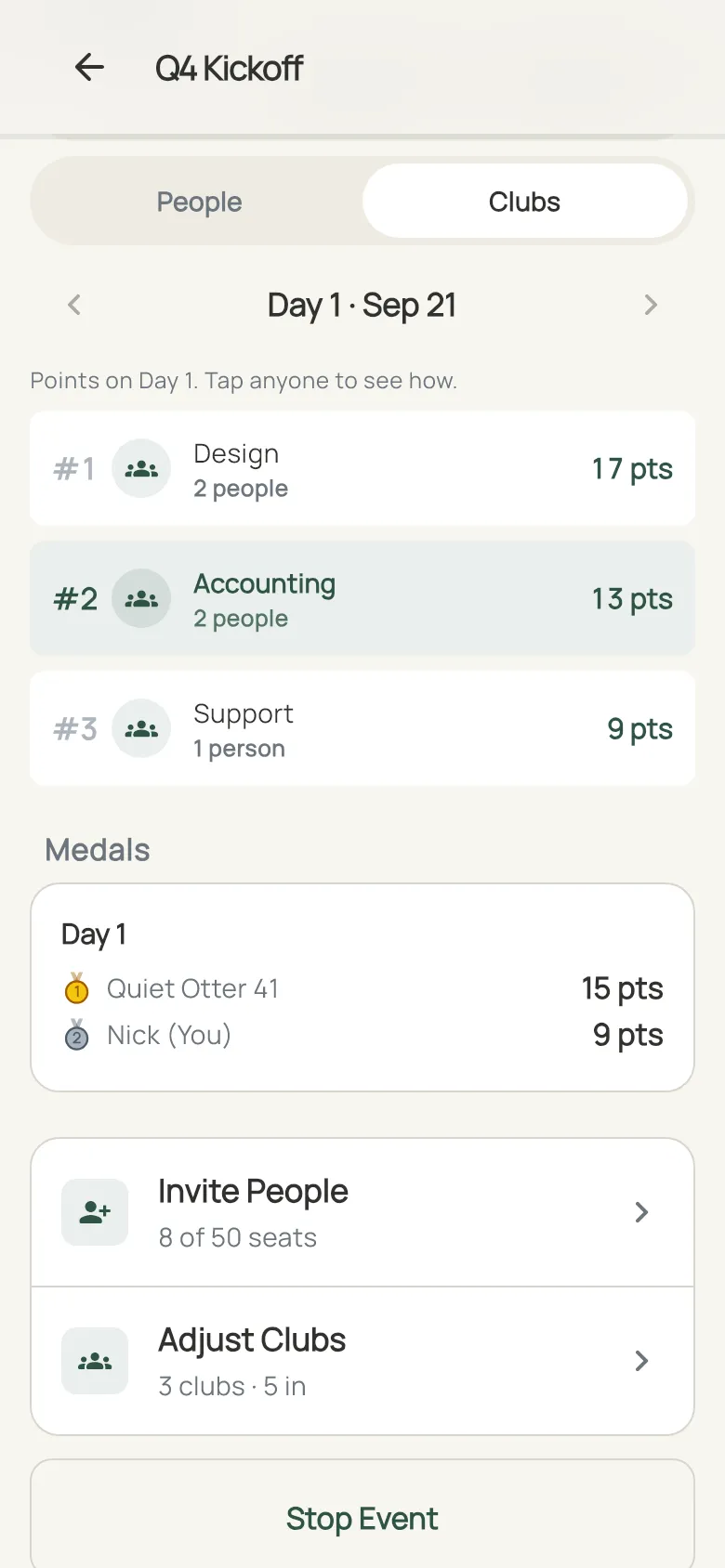
The event page leads with the day, the points so far, and today's set. Standings switch between Day, Week and the whole event, and between People and Clubs; tap anyone to see their points day by day. Medals go to the top three each day and each week. You can still move or remove people — their points go with them — and Stop Event ends it early.
8. When it ends
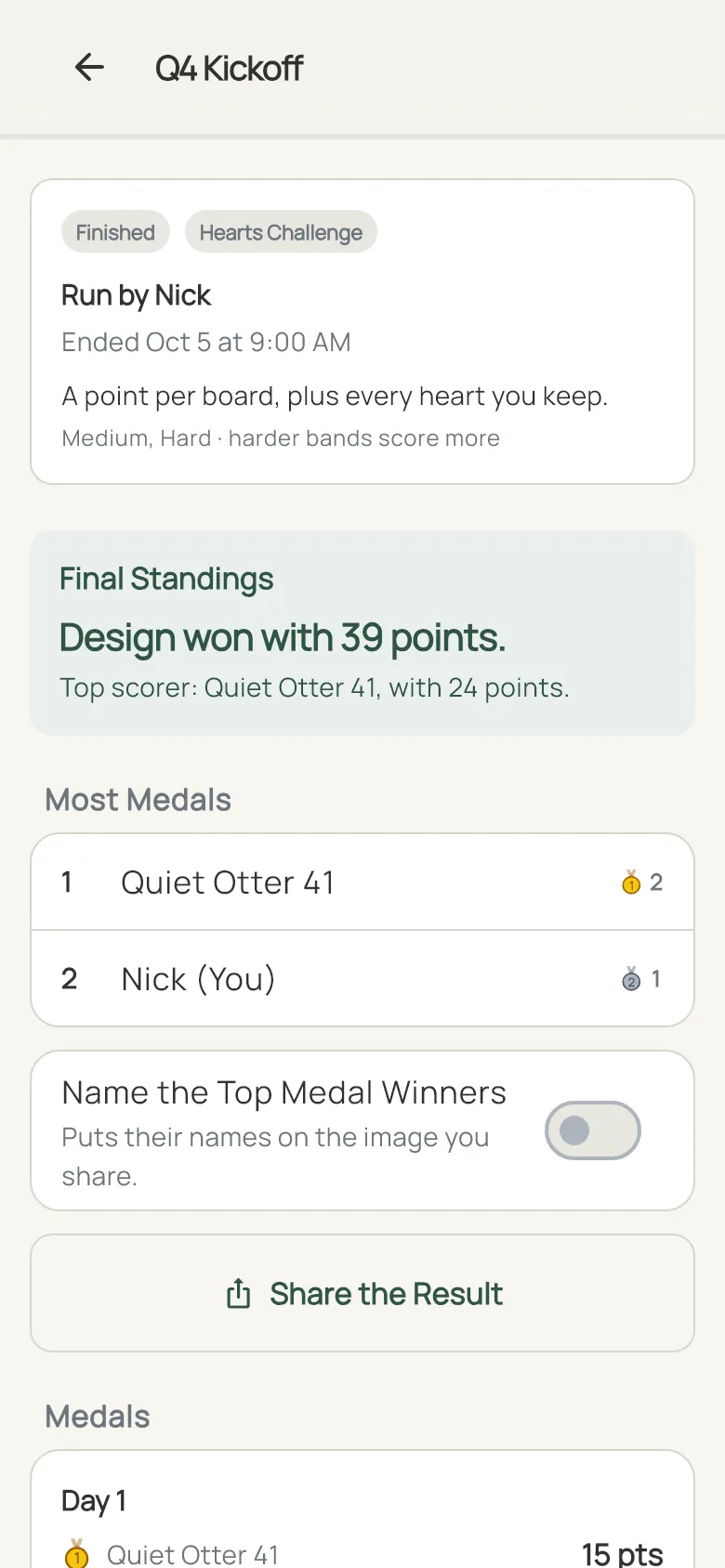
Final Standings names the winning club in a sentence, Most Medals lists who won the most, and Share the Result makes an image for the group chat — the winner and the top clubs, with no individual names on it unless you choose to add the top medal winners. Anyone who took part can then tap Duplicate This Event to set up the next one.
What's already decided for you
A new event is playable without touching any of this. These are the defaults, and the reason you might move one.
Club Scoring
A new event uses Average per person
Change it when Never, if your clubs are different sizes — that's what Average is for. Total adds the points up instead, which gives the biggest club the advantage of its size
Placing People
A new event uses Into the smallest club
Change it when You want to choose clubs yourself, or set one on each invite
Difficulties
A new event uses Medium only
Change it when You want people to pick their own — tick Easy, Hard or Extra Hard too
Harder Bands Score More
A new event uses Off
Change it when You want an Extra Hard board to be worth four Easy ones
Games
A new event uses Every game
Change it when Your group wants words only, or numbers only, or Sudoku only
Boards Each Day
A new event uses 5
Change it when Ten minutes a day is too much to ask — take it down to as few as 1
Practice Boards That Score Each Day
A new event uses 10
Change it when You want practice to count for more, for less, or without a cap
Members See Each Other's Email
A new event uses On
Change it when Nobody in the group should see the addresses — each person also chooses their own
One thing to know if you pick the Hearts challenge: the five games that have no hearts — Cipher, Lattice, Parcel, Tumbler and Word Search — are greyed out and named when you choose games, because every board of theirs would score the same.
The limits, in one place
People
50
counting you, and every invite nobody has answered yet
Clubs
2 to 10
named for you — Otters, Finches, Foxes — and renameable any time
Length
1, 2 or 4 weeks
from the date and time you choose, in your timezone
Boards a day
Up to 5
the same boards for everyone, made for your event alone
At once
1 running event
plus up to 3 drafts you haven't opened yet
Cost
Free
an Early Player Bonus while custom events are new
Somebody added you to a puzzle challenge.
It's a step challenge for your brain. Do a puzzle, get a point, repeat — and like a step challenge, nobody is judged on pace, and the points are for your club rather than for you. Dayzle is a daily puzzle app — Sudoku, word games and visual logic, across more than twenty games. Here's what you're being asked for, what it costs, and what the other people in it can and can't see.
You don't need a work account
Your invite arrived at an address, but it isn't tied to one. Each invite carries its own code, and the code is what holds your seat — so whichever Dayzle account you're signed in to when you open it is the one that joins. Use a personal email, or Sign in with Apple or Google, or the Dayzle account you already play on. You don't need a second account, and you never have to sign up with your work email.
Using a personal account doesn't hand that address over either. The organizer sees the address they invited beside your name, so they know which colleague you are — never the email you actually sign in with.
What it asks of you
Up to five short puzzles a day — Sudoku, word games, visual logic — on your own phone, whenever suits you. About ten minutes. Miss a day and you've missed a day: nothing is deducted and nobody is told. The one catch is that you can't go back for it — each day's set is replaced by the next one at midnight, so there's no catching up at the weekend.
What it costs
Nothing. Dayzle is free to play and joining an event is free. There's no trial, and nothing to buy to take part.
What you need
Dayzle on your phone, and a Dayzle account. Ordinary play needs no account at all, but an event does — it's how your points stay yours across devices.
How to accept
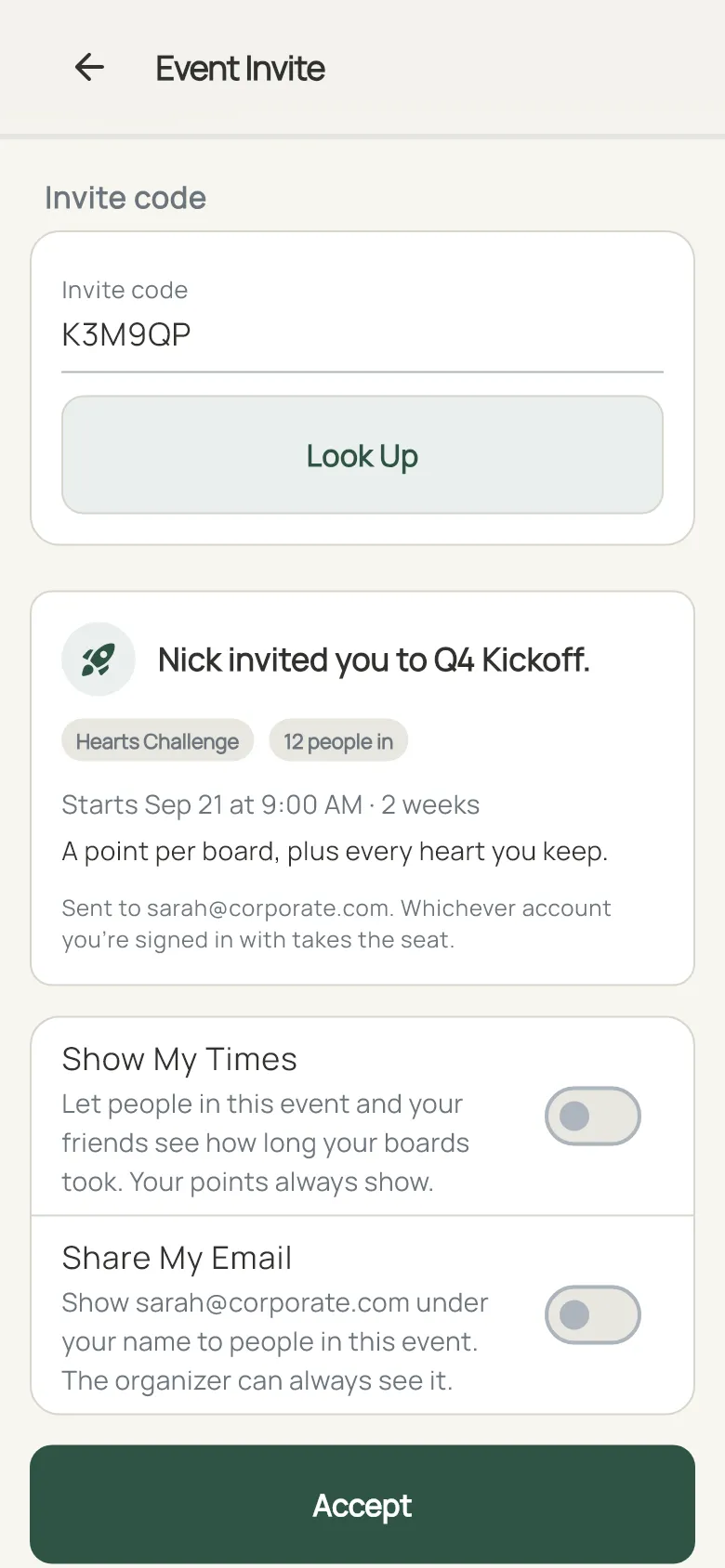
Tap Open the Invite in the email, open the link you were sent, or in the app go to Events and tap Enter Invite Code. Then tap Accept. Whichever Dayzle account you're signed in to at that moment is the one that joins. Nothing happens until you tap it — opening a link takes no seat — and each invite works once.
What other people can see
Your Dayzle name and your points. Not your solve times, unless you turn on Show My Times. Not your email address, unless the organizer allows it and you turn on Share My Email. Not your real name, unless you chose it as your Dayzle name. Nothing from an event reaches Dayzle's public leaderboards — and nobody outside the event sees any of it, because only the people in it can read the event at all.
If you'd rather not
Not Now leaves the invite where it is and asks again next time. Decline ends it, gives your seat back to the organizer, and lets them know — so they aren't waiting on an answer that never comes. Joining later would need a fresh invite.
On a day you're busy
Any practice board you win, in any game, scores in the event too — ten a day unless the organizer changed it. So a day where you'd rather play one Sudoku than the whole set still counts for your club.
Leaving, and changing your mind
Leave Event keeps your points and frees your seat, and Rejoin Event puts you back in the same club with the same points, any time while the event is still running.
One thing that surprises people: your ordinary Dayzle streak still comes from your daily set, not from the event. Event boards count as practice — they feed your stats and your Brain Score, and they earn points for your club.
Four emails, and that's all.
Worth reading before you paste a list of your colleagues' work addresses into anything. Every one comes from Dayzle Events, and every one carries an unsubscribe link that stops Dayzle event email to that address and nothing else.
When you open the event
“[Your name] invited you to [Event] on Dayzle”
How the challenge is scored, when it starts, a button that opens the invite, and the code itself for someone who installs the app first. Opening the link spends nothing — a seat is taken only by Accept in the app, which matters because company mail scanners open every link before the person does.
The day before it starts
“[Event] starts tomorrow”
When it starts, how it's scored, how many weeks it runs, and which club the reader is in. Sent from 8:00 AM in your timezone, so it never lands at midnight.
At the end of each event week
“[Event]: week 1 standings”
The top three clubs for that week, and the reader's own week — their points and where their club came. The final week has none, because the final standings follow within a day.
When the event ends
“[Event]: final standings”
Who won, in one sentence, the top three clubs, and the reader's own event.
Anyone can turn the last three off for themselves in Dayzle under Profile, then Notifications, then Event Emails. An address that never joins an event hears from us once, and not again.
Questions organizers ask.
What does it cost?
Nothing. Dayzle is free to play, joining an event is free, and creating one is free right now as an Early Player Bonus while custom events are new. There are no seats to buy and nothing for the people you invite to pay.
Does everyone need to install the app?
To play the boards, yes — on an iPhone, iPad or Android phone. Setting an event up, inviting people and reading the standings all work in a browser at play.dayzlegame.com, so you can run the organizing half from your desk while everyone plays on their phones.
Who else can see the event?
Only the people in it. An event is invite-only and unlisted — there's no directory to browse, no search, and no shared code anybody could pass on, so the only way in is an invite made for one person that works once. Its name, clubs and standings are readable by members alone, enforced on the server rather than by hiding a button, and nothing from it reaches Dayzle's public leaderboards or anyone's app-wide medals. The one thing to handle carefully is a copied invite link: it's the key to its own seat, so whoever opens it takes that place. Hand links to people directly rather than posting one in an open channel, and revoke any that goes astray.
Do people have to sign up with their work email?
No, and it's worth telling them so — it's the thing that stops people joining. An address is only how the invite is delivered. Each invite carries its own single-use code, and whichever Dayzle account the person is signed in to when they open it takes that seat, so a work invite can be accepted on a personal account and anyone who already plays Dayzle keeps the account they have. You can still tell who is who: every person in the event is listed with the address their invite went to underneath, and you see that whether or not you let members see each other's addresses.
Can people join after it has started?
Yes. Invite them any time while the event runs; they're emailed their link straight away and land in the smallest club when they accept. They will have missed the earlier days' boards, which can't be gone back to.
What if half the team forgets to play?
Then their club scores less — average scoring doesn't soften that, because somebody who stays in the event and doesn't play is a zero in their club's average just as surely as they're a gap in its total, and there's no catching up at the weekend because each day's set is replaced at midnight. What actually helps: make the daily ask smaller by setting Boards Each Day to one or two, and lean on practice counting, so anyone who plays anything at all contributes. Dayzle nudges on its own with a dot on the Events tab until the day's boards are done and a standings email at the end of each week. And if somebody is genuinely out for the month, Leave Event takes them out of their club's average rather than leaving a zero in it.
Can somebody catch up on a day they missed?
No — and it's the one thing worth saying when you send the invite round, because people plan to catch up at the weekend. Each day's set is replaced by the next one at the organizer's midnight, and yesterday's boards can't be reopened. A missed day simply scores nothing; there's no deduction and nobody is told. If your group is likely to be busy, set Boards Each Day to two or three rather than five — a day somebody actually finishes is worth more than a day they abandon.
Can my manager see how I did?
Everyone in the event can read the standings, which show each person's Dayzle name and their points. Solve times are hidden unless that person turns on Show My Times. Your real name never appears unless you chose it as your Dayzle name, and nothing from an event reaches Dayzle's public leaderboards.
Can someone be in more than one event?
Yes. You can run one event at a time, but there's no limit on how many other people's events you're in — and a practice board you win scores in all of them.
What if somebody drops out?
Leaving keeps their points and frees their seat, and they can rejoin any time while the event is still running. As the organizer you can also move people between clubs or remove them; points go with the player.
Do event puzzles count toward my streak?
Your daily streak still comes from your daily ritual — the five-game set or Today's Sudoku. Event boards count as practice: they feed your stats and your Brain Score, and they earn points in the event.
Can I run the same event again next quarter?
Yes. Duplicate This Event copies the settings, the clubs and the invite list into a fresh draft with new links; you set a new start date and open it. Anyone who took part can duplicate it, not just the organizer.
How do I stop the emails?
In Dayzle: Profile, then Notifications, then Event Emails under By Email. Every event email also carries an unsubscribe link, which stops Dayzle event email to that address and nothing else — an invite link still works afterwards.
Your first event takes about five minutes to set up.
Get Dayzle free, sign in, and tap Events. You can build the whole thing in a browser if you'd rather do it at your desk — the day's boards are played on a phone.